

Kevâkib-i Seb'a
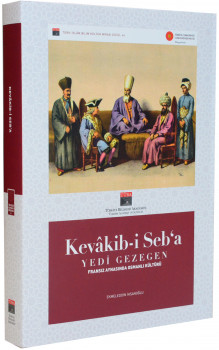
In Europe, particularly in France, during the first half of the 18th century, as a result of growing curiosity about the Ottoman Empire among intellectual circles, a desire to learn about the literature of the Ottomans (or the “Turks” as they were referred to) emerged among members of the cultural movement known as the “Republic of Letters.” Prompted by the curiosity of one of this circle’s members, the Marquis de Caumont of Marseille (Marquis de Avignon), and following extensive correspondence and contact with an official named Peyssonnel working at the French embassy in Istanbul, a connection was established with the Ottoman high bureaucracy, and a request was made to an unnamed member of the ulema to write a work on this subject. Thus, in the early months of 1739, the treatise Kevâkib-i Seb‘, (The Seven Planets) was published. The unnamed author from the Ottoman ulema wrote the work in a short time, but apart from the lists of scientific terms mentioned in the text, it was never translated into French. Nor is there any information about this anonymous scholar in the correspondence exchanged between Marseille and Istanbul. In the publications on Kevâkib-i Seb‘a to this day, the author’s identity, the story behind the work’s composition, and its content have not been addressed and examined to the extent they deserve. Although the treatise, written within the framework of Ottoman-French friendly relations, addresses exceptionally important and sensitive issues regarding how it was composed and how it addressed its audience, these aspects have not been examined with the necessary diligence. The author explains in his treatise the Ottoman understanding of science, the classification of sciences, and the various stages of educational life from its earliest stages to its conclusion. It provides information in a systematic, categorized format regarding the courses taught in madrasas, the textbooks and reference works used, and their authors. This study, which identifies the content of the Kevâkib-i Seb‘a treatise as well as the author’s identity, social circle, mindset, and intellectual world, is of a nature that will pave the way for future research and studies.
The work presents the text of the Kevâkib-i Seb‘a treatise, which exists as a single manuscript, to the reader in the Ottoman Turkish alphabet exactly as it appears in the original.