


TÜBA, Joint Declaration for the Advancement of Science and Technology in Asia
TÜBA signed the “Declaration on the Advancement of Science and Technology in Asia” following the discussions at the 2024 Asian Science Academies Forum organized by the Korean Academy of Science and Technology (KAST).
The forum was held in November 2024 at the invitation of KAST, with the participation of Prof. Muzaffer Şeker, President of TÜBA, and Prof. Ahmet Nuri Yurdusev, Full Member of TÜBA and President of the Association of Asian Science Academies and Societies (AASSA), as Asian countries are becoming increasingly influential on a global scale in various fields such as economy, culture and science, and the importance of science and technology as the main driver of national growth has increased. A joint declaration was published based on the ideas, suggestions and predictions put forward at the forum.
In addition to TÜBA, representatives of KAST, AASSA, Nepal Academy of Science and Technology, Malaysian Academy of Sciences, Academy of Sciences of the Republic of Uzbekistan, Indonesian Academy of Sciences, The Science Council of Japan, Pakistan Academy of Sciences and The National Academy of Science and Technology of the Philippines participated in the declaration.
Joint Declaration for the Advancement of Science and Technology in Asia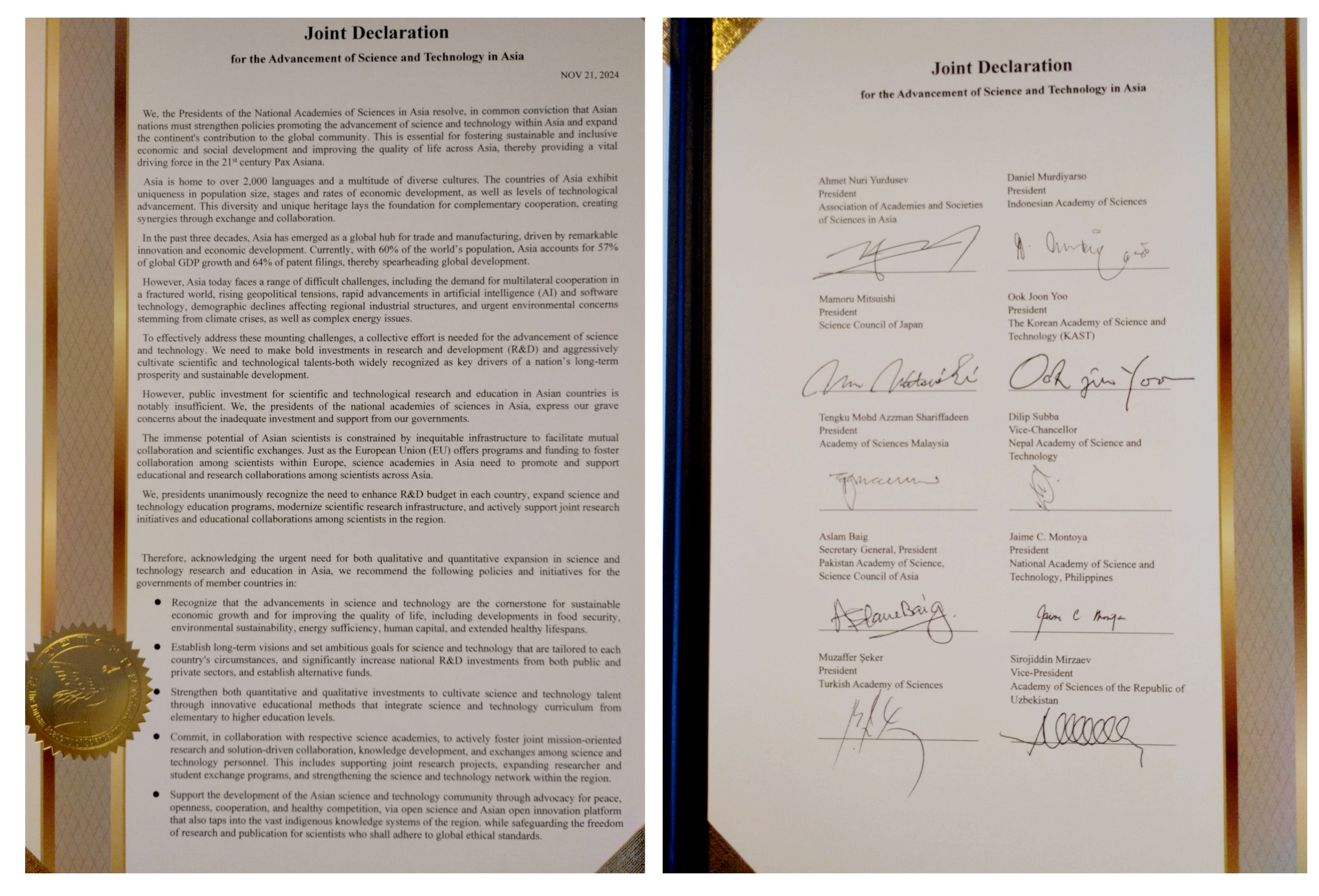 We, the Presidents of the National Academies of Sciences in Asia resolve, in common conviction that Asian nations must strengthen policies promoting the advancement of science and technology within Asia and expand the continent's contribution to the global community. This is essential for fostering sustainable and inclusive economic and social development and improving the quality of life across Asia, thereby providing a vital driving force in the 21st century Pax Asiana.
Asia is home to over 2,000 languages and a multitude of diverse cultures. The countries of Asia exhibit uniqueness in population size, stages and rates of economic development, as well as levels of technological advancement. This diversity and unique heritage lays the foundation for complementary cooperation, creating synergies through exchange and collaboration.
In the past three decades, Asia has emerged as a global hub for trade and manufacturing, driven by remarkable innovation and economic development. Currently, with 60% of the world’s population, Asia accounts for 57% of global GDP growth and 64% of patent filings, thereby spearheading global development.
However, Asia today faces a range of difficult challenges, including the demand for multilateral cooperation in a fractured world, rising geopolitical tensions, rapid advancements in artificial intelligence (AI) and software technology, demographic declines affecting regional industrial structures, and urgent environmental concerns stemming from climate crises, as well as complex energy issues.
To effectively address these mounting challenges, a collective effort is needed for the advancement of science and technology. We need to make bold investments in research and development (R&D) and aggressively cultivate scientific and technological talents-both widely recognized as key drivers of a nation’s long-term prosperity and sustainable development.
However, public investment for scientific and technological research and education in Asian countries is notably insufficient. We, the presidents of the national academies of sciences in Asia, express our grave concerns about the inadequate investment and support from our governments.
The immense potential of Asian scientists is constrained by inequitable infrastructure to facilitate mutual collaboration and scientific exchanges. Just as the European Union (EU) offers programs and funding to foster collaboration among scientists within Europe, science academies in Asia need to promote and support educational and research collaborations among scientists across Asia.
We, presidents unanimously recognize the need to enhance R&D budget in each country, expand science and technology education programs, modernize scientific research infrastructure, and actively support joint research initiatives and educational collaborations among scientists in the region.
Therefore, acknowledging the urgent need for both qualitative and quantitative expansion in science and technology research and education in Asia, we recommend the following policies and initiatives for the governments of member countries in:
Recognize that the advancements in science and technology are the cornerstone for sustainable economic growth and for improving the quality of life, including developments in food security, environmental sustainability, energy sufficiency, human capital, and extended healthy lifespans.
Establish long-term visions and set ambitious goals for science and technology that are tailored to each country's circumstances, and significantly increase national R&D investments from both public and private sectors, and establish alternative funds.
Strengthen both quantitative and qualitative investments to cultivate science and technology talent through innovative educational methods that integrate science and technology curriculum from elementary to higher education levels.
Commit, in collaboration with respective science academies, to actively foster joint mission-oriented research and solution-driven collaboration, knowledge development, and exchanges among science and technology personnel. This includes supporting joint research projects, expanding researcher and student exchange programs, and strengthening the science and technology network within the region.
Support the development of the Asian science and technology community through advocacy for peace, openness, cooperation, and healthy competition, via open science and Asian open innovation platform that also taps into vast indigenous knowledge systems of the region, while safeguarding the freedom of research and publication for scientists who shall adhere to global ethical standards.